Business website
Dox Defense Tech
A website for a security and connectivity company that works where the cell network stops.
- My role
- Design and development
- Platform
- Web
- Status
- Live
- Built with
- Next.js, TypeScript, Tailwind CSS, Cloudflare Turnstile, Nodemailer

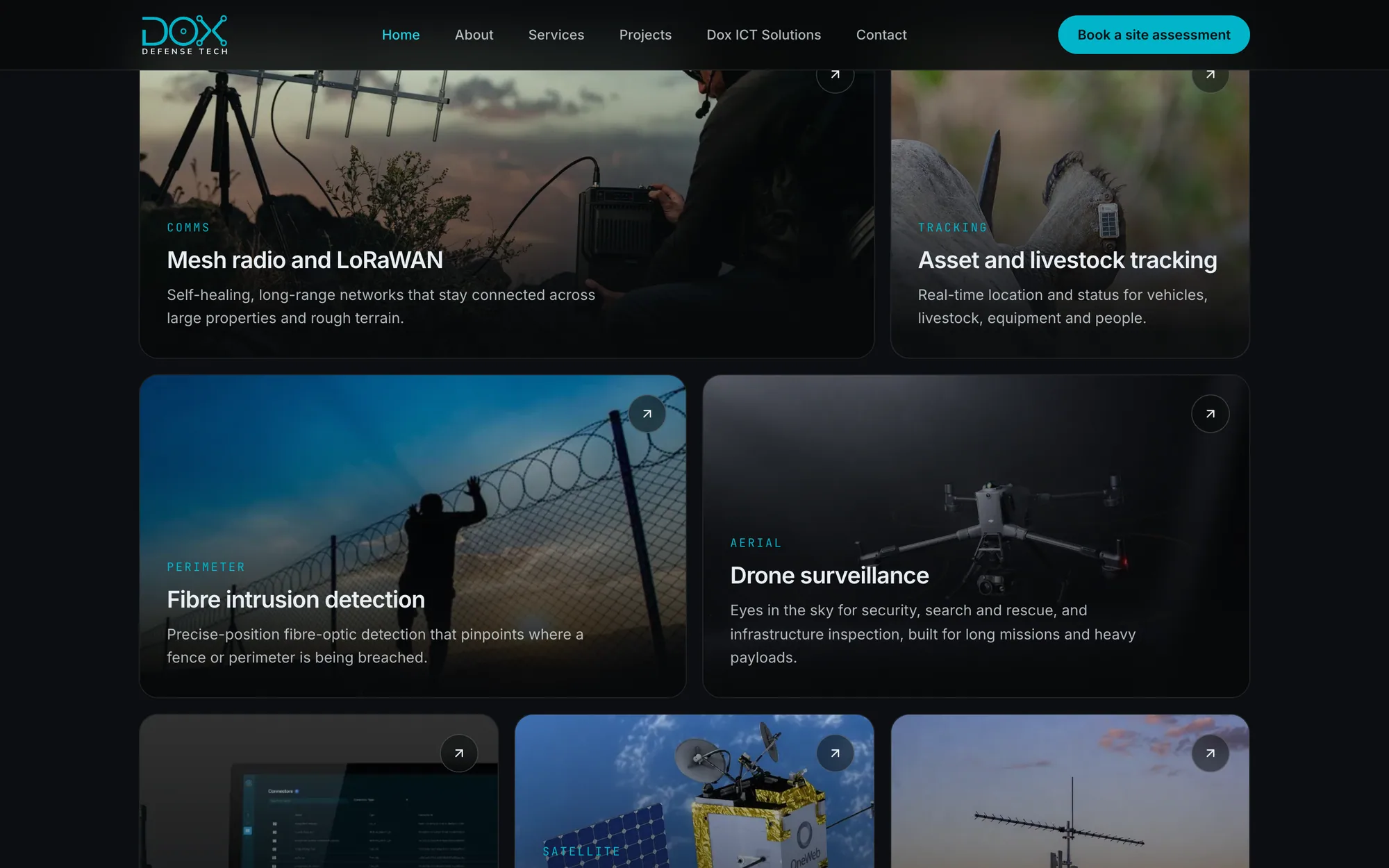

Dox Defense Tech, based in East London, designs, supplies and supports farm and reserve security, livestock and asset tracking, and radio networks for remote parts of South Africa. Its customers are landowners and rangers, not engineers, so the website has to explain mesh radio, LoRaWAN and fibre intrusion detection in plain language and turn that into a booked site assessment. I designed and built it.
Technical products, explained for the people who buy them
The site opens on one problem, that most of the land worth protecting has no signal, and builds everything else on it. Each capability gets a plain-language card with real photography from the field. Pages are organised around who is buying: farms, game reserves and anti-poaching teams, lodges, and patrol and response teams.
- 01
One clear next step
Every page leads to “Book a site assessment”, with a sticky call, WhatsApp and booking bar on phones.
- 02
Seven capabilities, one system
Mesh radio and LoRaWAN, asset and livestock tracking, fibre intrusion detection, drones, satellite, OneWeb and long-range WiFi, shown as parts of one design instead of a catalogue.
- 03
Built around the buyer
Use cases for farms, game reserves, lodges and response teams, a three-step assess, design and deploy process, and an FAQ that answers off-grid and load-shedding questions directly.
- 04
Technology that is named
The Ajax, Hytera, Ubiquiti UniFi, 3CX, Garmin inReach, OneWeb, DJI, ATAK and EarthRanger ecosystems are listed openly, and a Projects page explains mesh networking and the Reticulum Network Stack.
- 05
Two services, one site
A separate Dox ICT Solutions page covers managed IT, UniFi networking, phone systems and cyber security without muddying the main security message.
A booking form that respects the visitor
The site is a static Next.js build with one server route behind the booking form. The form asks for what the team needs to prepare, including an optional Google Maps pin for the property, and sends the team a formatted HTML email they can answer straight away.
- 01
Spam protection without friction
Cloudflare Turnstile and a hidden honeypot field keep bots out without asking visitors to pick traffic lights.
- 02
POPIA consent
The form asks for explicit consent under South Africa’s Protection of Personal Information Act, and links to a plain privacy notice.
- 03
Email that arrives
Requests are sent over the company’s own mailbox by SMTP, with the visitor’s address set as reply-to. The form fails with a clear message and phone number if sending ever breaks.
- 04
Ready for search and AI
A sitemap, schema.org structured data for the organisation, services and FAQ, a social share image, and llms.txt files that describe the business to AI tools.
Built with
- Next.js
- TypeScript
- Tailwind CSS
- Cloudflare Turnstile
- Nodemailer
- Vercel
Next case study
Productify.ai
Start a project
Got
something
to build?
A site that needs to be better, an app that needs to exist, a platform that has outgrown its tools. Tell me what it is and I’ll tell you honestly how I’d approach it.
hi@rudilouw.com